
The air-to-air missile is to form the main interception armour of the indigenously developed Light Combat Aircraft.

India on Tuesday successfully test-fired the nuclear-capable strategic ballistic missile Agni-IV from a test range off the Odisha coast.
It hit a target dropped from an AN-32 aircraft.
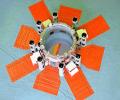
The Indian Space Research Organisation will open 2025 scoring a century orbiting the country's navigation satellite 2,250 kg NVS-02 with its rocket Geosynchronous Satellite Launch Vehicle (GSLV)-F15.
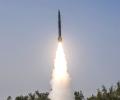
After a vertical lift-off at 12.15 pm from launch pad number three at the ITR, 15 km from Balasore, the surface-to-surface missile rose into the sky leaving behind a ribbon of white smoke, defence sources said.

The surface-to-surface Prithvi-II missile is capable of carrying 500 kilogram to 1,000 kg of warheads and is thrusted by liquid propulsion twine engines
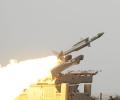
The missile targeted a floating object supported by the pilot-less target aircraft 'Lakshya', defence officials said.

Agni-V is a three stage missile, 17 metres tall, two metres wide and capable of carrying 1.5 tonne of nuclear warheads.

Designed to be a quick reaction missile, it has a strike range of 25 km to 30 km.
Akash was aimed at a target attached to Lakshya, the pilotless target aircraft.

The missile has a strike range of more than 2,000 km.

India on Friday successfully test-fired its indigenously developed nuclear-capable surface-to-surface Prithvi II missile, with a range of 350 km, from a test range near Balasore as part of a user trial by the Army.

India on Friday night successfully conducted maiden night test of its indigenously developed nuclear-capable Agni-I ballistic missile with strike range of 700 km from a test range off Odisha coast as part of a user trial by the Army.

The tests were conducted by the Indian Air Force, which will be the first service to induct the Akash missiles in its inventory.

Inducted into India's SFC in 2003, Prithvi II, the first missile to be developed by DRDO under India's prestigious Integrated Guided Missile Development Programme is now a proven technology
The sleek missile having 4000 km strike range is a two stage missile. It is 20 metre-long weighing 17 tonnes.

India on Monday successfully test-fired indigenously developed nuclear-capable Prithvi-II missile -- with a strike range of 350 km -- from a test range at Chandipur near Balasore in Odisha.

In fresh trials, India has test-fired its indigenously developed Nag anti-tank guided missile, which can hit a target up to seven km, from a helicopter at a firing range in Jaisalmer in Rajasthan.
India on Monday successfully test-fired its indigenously developed nuclear capable Prithvi-II missile, which has a strike range of 350 km, as part of a user trial for the defence forces.

India on Monday successfully test-fired its nuclear-capable strategic missile Agni-IV, with a strike range of about 4,000 km, from a test range off the Odisha coast.

Agni-IV missile is equipped with 5th generation onboard computer and distributed architecture. It has the latest features to correct and guide itself for in-flight disturbance.
Describing the launch of the sophisticated missile as a complete success, ITR Director M V K V Prasad said all the mission parameters were met during the trial. "The missile was randomly chosen from the production stock and the launch activities were carried out by the specially formed Strategic Force Command and monitored by scientists of Defence Research and Development Organisation as part of training exercise," sources said.

Twice every 12 days, the NISAR satellite will scan nearly all of earth's land and ice surfaces to measure changes in the planet's ecosystems, growth and retreat of its land and sea ice, and deformation of its crust.
Describing the trial as a "complete success", they said all mission objectives were met during the test-fire. All radars, tracking systems and range stations tracked and monitored the flight performance of the missile, which was launched with support of a mobile launcher.
Describing the trial as "fully successful", the sources said, the sophisticated missile travelled for 19 minutes and covered 4,900 km.
India on Tuesday successfully test-fired for the second time in two days its indigenously developed nuclear-capable Prithvi-II missile, which has a strike range of 350 km, from a test range at Chandipur.
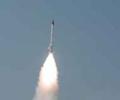
India on Sunday successfully test-fired a new interceptor missile capable of neutralising any incoming long-range missile at higher altitude.

The missile successfully flew in its pre-set trajectory meeting its mission objectives
As part of its plan to deploy a two-layer ballistic missile defence system, India on Friday successfully test-fired its indigenously developed supersonic interceptor missile from the Integrated Test Range off Odisha coast. A surface-to-surface target missile -- a modified 'Prithvi' -- was first lifted from the launch Complex III in ITR at Chandipur, 15 km from Balasore around 10.13 am, defence sources said.
India on Saturday successfully conducted two rounds of trials of its indigenously developed surface-to-air Akash missile as part of a user trial by the Indian Air Force from the Integrated Test Range at Chandipur near Balasore in Odisha.

India on Sunday successfully test-fired its medium-range nuclear-capable Agni-II missile with a strike range of more than 2,000 km from the Wheeler Island off Odisha coast as part of a user trial by the army.

The conversion facilitated range enhancement and improvement in Pinaka's accuracy.
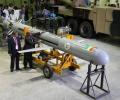
This was the fifth experimental test of the homegrown missile system.

Many new technologies developed indigenously were successfully tested in the Agni-5 trial.

The missile is capable of intercepting incoming targets at an altitude of 15 to 25 km was launched against multiple simulated targets of 1,500 km class ballistic missile.

The successful test will result in huge savings of replacement cost of missiles held in the inventory of the Indian Armed Forces.
India on Sunday conducted a second test flight of its indigenously developed nuclear-capable Agni-V long-range ballistic missile, which has a strike range of more than 5000 km, from the Wheeler Island off Odisha coast.
The proposal is also important as it comes at a time when the Indian forces are working on the creation of a rocket force which has been in discussion at the highest levels in the Defence Ministry.
With an eye to develop a full fledged multi-layer Ballistic Missile Defence system, India is likely to test-fire its indigenously designed and developed Advanced Air Defence missile from the Integrated Test Range off Orissa coast on Sunday.
